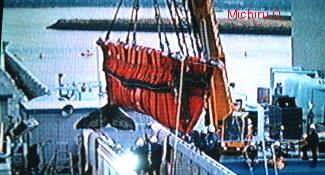
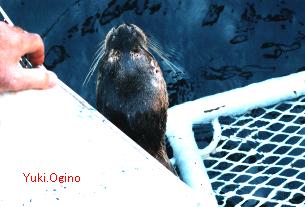
‚o1FRescue of Marine Mammals
›Earl Richmond (Marine Mammal
Center, U.S.A.), Michiru Ogino, Yuki OginoiNatl.SciDMusDCTokyoj, and
Koji Tokutake (Aqua MusDHakkeijima)
 |
 |
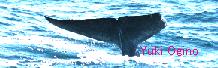
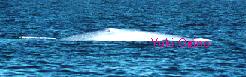
‚o2FBluewhales of Baja California:a report of
the survey by sighting and photographing 1998-1999.
›Yuki Ogino and Michiru Ogino
(National Science Museum Friendship Club)
 |
 |
‚o3FTransportation of Pacific white sided dolphins
incidentally caught in set nets off Nanao, Toyama Bay.
›Tetsuya Matsuoka, Toshirou Okeda,
Masafumi Kato, and Yoshiaki Komatsu (Notojima Aquarium)@
‚o4FGonadal histology of the marine mammals stranded
on the coast of Toyama (Etchu) and Niigata (Echigo) Prefectures, Sea of
Japan.
›Yoshiharu Honma, Tatsuo Ushiki,
Masaei Takeda (3rd Dept. Anat.,Niigata Univ. Sch. Med.), and Junji Shindo
(Niigata City Aquar.)
‚o5FCetacean strandings in the coasts of Yamagata Prefecture,
Japan during 1998-1999.
.›Kazuo Nagasawa (Yamagata Prefectural
Museum), Tadasu K. Yamada, Toshiaki Kuramochi (National Science Museum),
Junji Shindo (Niigata City Aquarium), and Suburu Oba (Yamagata Prefectural
Museum)
Five cases of cetacean stranding were recorded in the coasts of Yamagata
Prefecture, Japan during 1998-1999. The cetaceans were identified as four
Mesoplodon stejnegeri and one Lagenorhynchus obliquidens.
Three of them were pathologically examined in the field or laboratory.
Some new biological data were obtained; however causes of stranding and
death still remains unsolved.
During the last seven years, thirteen cases of cetacean stranding were
recorded in Yamagata Prefecture, including the five above. Ten were M.
stejnegeri. Therefore, like along other stretches of the Sea of Japan
coast, the stranded species are more likely to be M. stejnegeri
than any other species. Further stranding surveys will be required to understand
which cetacean species live in the Sea of Japan and to know their biological
characteristics.
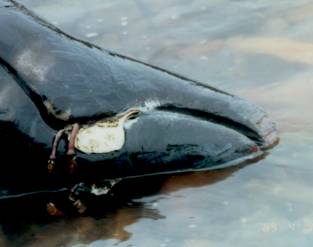
‚o6FStranding of mesoplodont whales in the Republic
of KoreaD
Koo-byong Park (Institute of History of Fisheries, Korea) and ›Tadasu
K. Yamada (National Science Museum)
 |
‚o7FThe Mibiki site with dolphin bones of the Early
Jomon period (c.6000 B.P.) at Tazuruhama-machi in Ishikawa Prefecture.
Yoshitaka Kojima and Tetsuya Kanayama (Ishikawa Archaeological Foundation)
‚o8FAnthracosis found in the lung and hilar lymph node
of the cetaceans.
›Akinori Shimada (Dept.Vet. Pathol.,
Tottori Univ.), Sumiyo Ishikawa (Analysis Center, Horiba Ltd), and Masahiko
Sato (National Institute for the Environmental Studies)
‚o9FThe Mawaki site investigation 1998 in Noto-machi,
Ishikawa Prefecture: Its outline and a view of the future.
The Noto-machi Board of Education, and the Mawaki Site Investigation Committee
| 10th Congress | Special Lecture | Oral Presentation |
| 9th Study Meeting | 11th Congress |