June 6-7/1998
›Michiru Ogino
and Yuki Ogino (The National Science Museum Friendship Club)
|
|
|
|
|
|
The blue whale is the world's largest animal. We can see
a life-size model of a blue whale in front of the National Science Museum
in Tokyo. We found it very exciting. However, we are not able to see blue
whales in the sea around Japan. Blue whales still show little sign of recovery
in the North Pacific area even after the whaling prohibition. We don't
know sufficiently either the actual number of blue whales or their behavior.
We had good opportunities to see blue whales in the Sea of Cortez and off
California between 1995-1998. We present some topics from what we obtained
during the last four years of our survey.
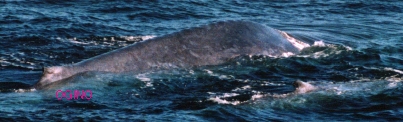 |
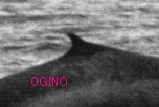
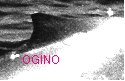
1) Photo identification
Researchers have taken black and white photographs of individuals for the
photo identification. They use the pigmentation pattern of the blue whale
body surface for identification in Quebec, Canada (Sears 1988). We have
taken color pictures and video footages by ourselves in our study. Photographic
identification of individuals has shown new information on the migration
and behavioral patterns of blue whales. From the blue whale pictures we
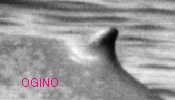
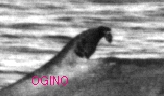
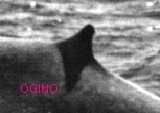
found that each dorsal fin have clear difference-useful for identification.
We can recognize there are several types of dorsal fin shapes in our pictures.
We have classified the dorsal fin patterns into categories.
2) Feeding behavior
Blue whales feed on "krill" in the Sea of Cortez Baja, California.
Blue whale's head breaks the surface, and we see the white big blow. Then
the broad U-shaped head disappears. We can then smell the krill in the
air. The krill that blue whales eat are very small. We have sometimes seen
feeding behavior of blue whales in our study. It is true that blue whales
feed off Baja California in spring.
3) Mother and Calf
We had good opportunity to see a mother and calf together in our survey.
The calf was swimming with its mother side by side. We think this is the
nursing behavior. We have seen the feeding behavior of a blue whale with
a little calf in the Sea of Cortez, too.
We will maintain our research of blue whales in order to obtain more results.
Our study has just begun. We think the photographic identification of individual
whales must be useful in the study of migration of blue whales and their
population size.
›Hisoka Hiruda and Staffs of Marine Mammals (Marine World Umino-nakamichi)
 |
MARINE WORLD UMINO-NAKAMICHI started the preparatory
work in 1987 and opened to the public in April, 1988 on completion of the
first phase plan. Marine World Umino-nakamichi celebrated the grand opening
in April, 1995 on completion of second phase plan.
THE MAIN THEME is@hTsushima Warm Currenth which covers breeding
and research programs for marine creatures along the northern coast area
of Kyushu. In particular, marine mammals such as the Bottlenose Dolphin
Tursiops truncatus gilli, the Pacific White-sided Dolphin Lagenorhynchus
obliquidens, Risso's Dolphin Grampus griseus, the Finless Porpoise
Neophocaena phocaenoides, the Irrawaddy Dolphin Orcaella brevirostris,
the California Sea Lion Zalophus californianus, the South American
Sea Lion Otaria byronia, and the Sea Otter Enhydra lutris kenyoni
are displayed with their breeding activities.
THE RESEARCH TOPICS are drifting, straying and the incidental catch
of marine mammals living along the coast of Fukuoka Prefecture. This report
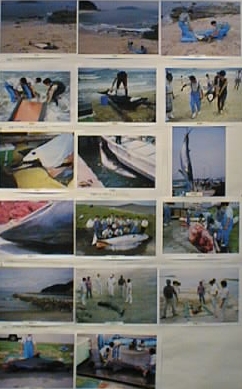
refers to the confirmed record of whales on the coast of Fukuoka Prefecture.
In ten years between 1987 and 1996, 35 cases totalling 36 whales of 9 species
had been confirmed. However there was no reporting in 1994. Of the 36 whales
the Finless Porpoise of No.13 and No.17 have been in breeding programs
and 21 cases are preserved as skeleton specimens. Other cases rely on photos,
newspaper articles and measurement data to greater extent.
AREAS FOUND: 21 cases were found in the Sea of Genkai, 9 in Hakata
Bay, 3 in Karatsu Bay and one in the Straight of Kanmon. Also, one case
was reported from the Sea of Suo, though no report came from the Sea of
Ariake.
SPECIES: 18(51.4 %)of the whales were Finless Porpoises, 4(11.5
%) Mink Whale Balaenoptera acutorostrata, 3(8.5 %) Bottlenose Dolphins,3
Pacific White-sided Dolphins,2(5.7 %) cases each of Dwarf Sperm Whales
Kogia simus, Risso's Dolphin and the False Killer Whale Pseudorca
crassidens, and 1 case(2.9 %) each of the Pygmy Sperm Whale Kogia
breviceps and the Rough-toothed Dolphin Steno bredanensis.
SEASON WHEN CAUGHT: 19 cases(61.4 %) were reported between December
and April. On the other hand, reports from May to November were less with
1 to 3 cases monthly. In the case of the Finless Porpoise, some cases were
reported during November, but there were no report between June and October.
Reports of drifting, straying and incidental catch were 21 cases(60 %)
among all and 4 cases(11.5 %) of straying and 10 cases(28.5 %) of incidental
catch respectively.
INFORMATION SOURCES: On receipt of any report or information from
the Fishery Union, residents on coastal areas, the Press or Fukuoka Fishery
Experimental Station, we immediately start a series of research work and
bring specimens back for temporary preservation and report to the Fukuoka
Prefectural Office. In some cases, we apply to the Fukuoka Prefectural
Office for the permission to preserve them as specimens for research. In
the early stages reports came only from the neighboring Fukuoka Prefecture.
Now, however many reports and much information come from further afield
such as Yamaguchi, Saga, Miyazaki, Nagasaki and other remote Prefectures.
We are always ready to act on any report or information.
›Osamu Sano,
Syoji Kunimoto, Toyoshi Saito, Junko Kanayama, Kazuyoshi Kakuta, Eisaku
Minami, Tatsuo Miyashita, Hajime Maruzen and Norio Kawashima (Preservation
Society of Fin Whale Stranded at Monzen)
 |
ZYuko
Tajima (Dept. of Vet. Pathol., Tottori Univ.), Tatsuya Oike (Minamichita
Beachland Aquarium), Akinori Shimada (Dept. of Vet. Pathol., Tottori Univ.)
Tomoaki Furukawa (The Toyama-shi Board of Education),
›Tetsuo Hiraguchi (Kanazawa Medical
University)
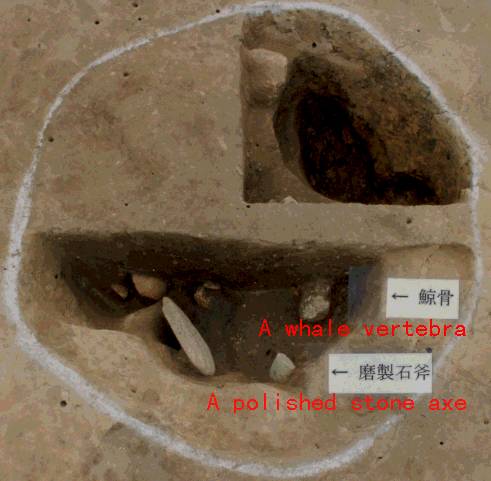 |
The Kitadai site was situated at latitude 36K42'10"
N and longitude 137‹11'20" E, on a hill 17 meters above sea level
and about 4.5 km away from the coast of Toyama Bay. This
paper reports a piece of a whale vertebra excavated, in July 1996, from
a pillar-hole (SB01-P1) of a building with pillars embedded directly in
the ground at the site of the later Middle Jomon-period (about 4000 B.P.).
It might be from a religious ceremony to purify a building site.
The whale piece was a left dorsal part of a cranial end of a caudal vertebra.
Its greatest length and breadth of the cranial articular surface were 9.3
cm ~ 5.4 cm. The vertebral epiphysis was completely fused with the body.
The same part excluding the epiphyses of a specimen of Fin Whale (Balaenoptera
physalus) which lived recently, had a greatest body length of 20 cm
and a greatest breadth of 30.5 cm of the facies terminalis cranialis
(= cranial articular surface). The only species in Toyama Bay or the near
seas with a caudal vertebra of this size is the Fin Whale.
The recent specimen was a young animal 15 meters in length. The estimated
value of the greatest width of the cranial articular surface of the whale
piece is slightly more than the specimen. The length of sexually mature
10 years old, Fin Whales is about 18 meters. Therefore, it is estimated
that the whale piece belongs to a Fin Whale larger than 18 meters in length.
Yoshimitsu Yamashita (Kumamoto Prefecture Board of Education, The Assoc. of Folklore in Amakusa)
 |
In the Amakusa and Ushibuka regions,from the rainy@season
to the "Bon" period, whales travel north along the shore of Amakusa.
However, there are no cases of whales having been caught in Amakusa. As
for bonito fishing, in many cases, bonito travel together with the whales.
Therefore, finding whales offshore meant a good omen for big catch yields.@There
are some cases of witnessing whales coming into the inside area of a bay
chasing sardines and also some cases of their corpses drifting ashore.
Whales are not only associated with the fishermen who spend their life
on the sea, but also with the weather forecast, New Year's dishes and names
of sea areas. Although in Ushibuka, bonito fishing has already been halted
and whales have stopped traveling north, the memory of these courageous
whales still remains in the hearts of the people.
Issei Kanada ( Kumamoto-shi Board of Education)
Shohji Kunimoto (Editorial Office of Ceto-ken News Letter),
Osamu Sano (Ishikawa Zoo.), ›Shigetoshi
Nishiwaki (Institute of Cetacean Research)
| 9th Meeting | Foreword | Commemorative Lecture | Oral Presentation |